Showing posts with label 2015 British Election. Show all posts

Friday, 8 May 2015

UK General Election 2015: The Day After - Controversy, Constitution and... Maggie Simpson?


Hi there,


In Britain today there is a rich, sometimes awed mingling of reactions to what has been an extraordinary night, in our constitutional history. Labour's implosion in England and particularly in Scotland, compounded by the disintegration of the Lib Dems and a strong, but limited showing from Ukip and Conservative effort has returned David Cameron, now with a majority of 331 seats, to the premiership.


In a day of remarkable drama, dashed and enlivened hopes, Britain now is compelled to carefully consider, after the passions of election, the future it faces.


Though we will consider the respective factors further, the electoral map below - displaying Westminster constituencies contested in 2015 - embodies the stark, imposing reality of the new political alignment in the UK. The SNP the great victor of the night, they have swept to power across Scottish constituencies once considered Labour and Lib Dem bastions. Winning an astonishing 56 of the nations's 59 seats with a general swing of 25-26% from Lab to SNP, all that remains of the other parties in Scotland follows succinctly: the rural borders of Dumfriesshire held by the Conservatives, metropolitan Edinburgh South held by a combination of Lab and Conservative support in a Labour Candidate, and the islands of Orkney and Shetland, narrowly retained by a decimated Liberal Democrat party. But, in England, the wider narrative played out to the confusion of pollsters, voters and parties alike...


Westminster constituencies election 2015 results - Scotland, England, Northern Ireland & Wales (image courtesy of BBC election night coverage)


South of the Scottish border, the electoral environment was hostile, convoluted and witness to remarkable moments in British electoral history. The Conservative Party mounted a confident campaign against their rivals, while Labour strode towards the election with some measure of confidence: aspirations of forming the next government indulged before hopes were dashed as the political dynamics England proffered gave eclectic results.


The Conservatives doing well, as did Labour, at the cost of a withering Liberal Democrat vote, Labour failed to find traction in the south, beyond their bastions in the midlands and in the north; these being taken by conservatives who also gave a strong showing in Wales where - astonishingly - Labour lost their bastion of Gower: loyal for over a century before being captured with just 27 votes for the Conservative candidate. Elsewhere, the demise of the Lib Dems - seen as part of the necessary process of restoring a Labour government - was compounded by Ukip drawing Labour support away, and ultimately attenuating efforts in many regions where Labour hoped for a breakthrough.


The controversial party of the right, Ukip followed in second or third place where Labour and the Conservatives fought, with their influence felt in many instances where thousands drew away from red, blue and yellow to support the purple pound of the arch euro skeptics. Conservative success at the expense of Labour, Lab's gains from the Lib Dems and Ukip frustrating the efforts of both the former two was a scenario played out in many key constituencies which - along with SNP victory in Scotland - resulted in a growing complexion which one canny twitter user remarked was rather like the infant Maggie Simpson of "The Simpson's" fame. A note worthy of a chortle or two...
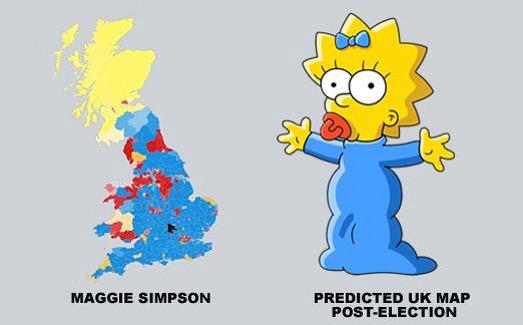

UK 2015 Post-General Election Map & Maggie Simpson (Uncanny)


By hours of daybreak, the future was looking bleak for Labour, disappointing for Ukip and atrocious for the Lib Dems; a once vigorous parliamentary party of 57 reduced to 8 in less than a day, memories of government growing distant as obscurity beckoned. The Conservatives returned with a majority of 331, Labour suffered a retreat of its fortunes not seen since the defeat of 1992 (the recent rendition of the play "The Absence of War" seeming darkly portentous, concerning the election), under Neil Kinnock; polling data, now having proved so despairingly aberrant, once evidence of a neck and neck race, now latently pointing to a decisive Labour decline, as exit polls contradicted their predecessors. Labour reduced to 232 seats, while their Lib Dem competitors retain only 8 seats - equal to the Northern Irish DUP -  their respective leaders sought immediate resignation; words bracing for a difficult future as both parties are destined to struggle in hopes of explaining their defeat - and to rebuild, come what may. The same was said of Ukip - the controversial Nigel Farage failing to win his seat as the party's role seemed more of a strategic hinderance than destined legislative force at this election, though now entering the House of Commons with one seat.

Resigned Party Leaders - 2015
Ed Miliband (Labour), Nick Clegg (Lib Dem), Nigel Farage (Ukip)


At the conclusion of this general election, a singular electoral experience, we arrive now at the threshold of a new paradigm in British politics. The Conservative Party seemingly victorious, David Cameron cannot afford to be indulgent with his second term: lacking a Scottish or wider British mandate while also facing a Conservative party galvanized by euro skepticism and the draw of social politics which could yet prove very difficult for wider British society to stomach, in the long term. More so, the SNP's victory in Scotland has compelled the astonishing understanding that Cameron may very well be the last Prime Minister of the UK, in its current constitutional complexion: Scotland's devolution set to grow and evolve into greater autonomy regardless of what some in the Conservative Party may consider of their northern neighbor. 


In addition, Labour heads to not only a leadership contest but to also a potential indictment of the party's governing social and political paradigm: the neo-liberalism of the 1990's and 2000's working to alienate voters, while a weaker stance on ethnic and social politics has undermined the party in some English seats of a increasingly conservative voting culture - a stance which Ukip capitalized upon to severely maul both Labour and the Lib Dems. The Lib Dems having been decimated, their future as a viable political force remains uncertain as the liberal tradition in present day England seems to be winding down to historical obscurity. Ukip, once hailed as the party to upset the establishment, were ultimately constrained and limited to one seat; their destined success seeming less surely purchased as their narrative corroded both Lab, Lib Dem and Conservative support without actually breaking through themselves. 


With the election now over, we have seen a remarkable few months come to a close as another, and possibly exceptional, chapter in British politics begins; Britain potentially realigning under a more articulated or heterogeneous federalism with the once linear politics of the Westminster paradigm fragmenting into more overtly ethnic, delineated models of democracy in the respective polities.


Wither such postulations come to pass, or if the UK has a future within a reconstituted, deeply reformed framework is debatable, though it will remain from this day onward that British politics - now and for many, many years to come - will never be the same again.


Clark Caledon.


Thursday, 7 May 2015

UK General Election 2015 - Election Day


Hi there,


In the second part of our UK election special, having introduced the principal parties, players and issues on the 6th of May, we now find ourselves at election day itself: polling centers opening across Britain early in the morning and closing at 10 pm tonight to allow voting for the relevant Westminster parliament constituency. What may come of these local battles will not only determine the complexion of the future parliament that will emerge tomorrow, 8th of May, but will also be but the first motion in the power play that is to follow: the complexion of any government - if there is no decisive victor - decided through coalitions, partnerships or wider constellations between the parties of a new parliament, which promises to be controversial and potently eclectic.


Polling Day in 650 UK Constituencies to determine the next Westminster Parliament


At the time of writing, just past eight o'clock in the evening, voting has been ongoing since seven in the morning, and now with just over an hour to go before polls close. After this, counting will begin in regional centers; the total votes cast allocated to those standing, after which will emerge a winner by the end. There is no exact time table for this, but it is known that Scotland will begin processing votes promptly with a good many constituencies declaring before three o'clock on the 8th of May, around six hours from now. From a while, before and after that, English and Welsh constituencies will begin declaring their results, as will Northern Ireland too. The last declarations will probably be around seven the following morning, though by that time electoral scenarios will probably have played out - positively or negatively - and a new government will be forming soon thereafter.


In this case, hung parliaments and coalitions now very much a recognized avenue of electoral politics, it remains that though a result similar to the 2010 election could be played out, the mainstream parties are now very much tested in their opinions and the infusion of much larger national, regional and special interest contingents (ie. SNP, Ukip, Green etc) will make the business of discerning a mandate more complicated. To this end, and for some months, a number of scenarios have been postulated, depending upon the resultant complexion of the electoral map come the early hours of May the 8th. This new plural parliament and its more negotiated mandate will succeed, in most part, the election of 2010: an event which saw the then odd situation of a hung parliament and with no decisive mandate for either Conservative or Labour, without a third or more parties aligning. Received with an air of controversy and still debated today, the election of 2010 could very well have prefigured many British-Westminster elections to come - in their candor and complexion - though if this is a compliment or indictment of the Westminster system, it remains to be seen...


The electoral map of the 2010 Westminster elections can be found below, with metropolitan regions of particular significance highlighted. Though the dynamics played out with some predictable direction - Labour deciding in metropolitan regions, Conservatives in the rural shires and Lib Dems a mingling of both with other parties performing to their own imperatives - it remained that neither Labour, Conservative or Lib Dem could sufficiently color the map to control the House of Commons, and thus form a government, without co-operation with another.

Map courtesy of Wereon on Wikipedia - image in the public domain.

2010 United Kingdom Electoral Map - Westminster Constituencies (Central Scotland, English Midlands and London highlighted)


This day playing host to a number of evolving socio-political narratives, imperatives and tendencies, local contests will have an accentuated significance, especially in the so called celtic periphery of Britain, while Labour, Conservative and Lib Dem will have a severe strain to press their support, wherever and whenever they find it, to supply MP's for their respective parties.


A remarkable election locally and nationally, in the four nations and in the British whole, what transpires in the next 24 hours will be interesting to consider; an emerging politics in motion, or perhaps a new configuration of British identities, in the decades after devolution, the financial crises, austerity culture and the dilution of a once presumed, singular mandate.


Time will tell, it seems...


Clark Caledon.

Wednesday, 6 May 2015

UK General Election 2015 - The Day Before


Hi there,


Today and the two that follow it will prove particularly interesting in my corner of the world. In the very least, we stand on the threshold of a general election for the United Kingdom's central legislature - the Westminster Parliament - and the further examination of Britain's democratic culture in the years after the financial crises, but also an event in which the dynamics are thoroughly unique. By nature a majoritarian, first-past-the-post system, usually dominated by the Conservative and Labour parties - latterly with the ostensibly centrist Liberal Democrats as the former's government partners - this election is one in which the central institutions of the British political system have been subjected to growing peripheral examination from nationalist, regional and special interest parties, working in the face of the centre's perceived deficits.


Over the last five years, we have seen many new and remarkable developments in British politics and in the tenor of the prevailing discourse: no longer as singular or as predictable as it once was, and with the marked growth of national, ethnic and social narratives pointedly removed from the once prevailing mainstream. Certainly deriving from events before the assumption of the Conservative-Lib Dem Coalition in 2010, it remains an indelible fact that government in Britain from this point onward has proven one galvanized by attempts to address the financial crisis of the late 2000's, but also the enduring legacy of that era has impelled many in the wider British polity to consider their world more critically. Now, on the eve of what must surely be something of a judgement concerning these past years - and the more complicated, charged ambiance they afford - it remains to consider what might become of the hours and days ahead.


Of course, there are a number of scenarios - with markedly more gravitas since coalition government became a fact and hung parliaments a feasible fixture of the new politics - and though some have more purchase than others, it does afford many intriguing possibilities for the future of governance in Britain.


Of the three ostensibly principle British parties - Labour, Conservative and Liberal Democrat (the latter no longer the third largest) - the former two still indulge dreams of a majority, while the latter would wish to inform and partner with the one bearing the firmer mandate. The polls to date reading as almost parallel between Labour and Conservative, the Lib Dems have made good on their obligation to give at least a brave front: no other choice prevailing in the face of their unpopularity and seemingly constrained profile in government.


The Labour Rose, Liberal Dove and Conservative Oak


In turn, as the focus and momentum has drawn away from the centre, we find the parties embodying this tendency: some new, some established and some refreshed by new, regional debate. The Scottish National Party have compelled a remarkable profile over the past few years. Winning a majoritarian style second term in Scotland's 2012 devolved elections, the party's fortunes were staked high for the Scottish independence referendum of 2014. Though ostensibly defeated, the party - having since become the focus of a wider, vibrant constitutional movement - experienced a surge in growth: passing 100,000 members to eclipse the Lib Dems as Britain's third largest party overall, and compelling a critical examination of Scotland's expanding powers of devolution as the Scottish and British polity's grow wider in their disjunction. Considering the possibility of them eclipsing Labour in Scotland's Westminster constituencies, they have been regarded - with some disdained fascination - as potential kingmakers to a future Labour government, if Labour can compromise towards a common, progressive imperative and does not win a majority.


 Stylised Saltire of the SNP


Considered to something of a ideological counterpoint to the aspirations and influence of the Scottish nationalists, is the resurgence of the seemingly ironic and English phenomenon of Ukip: the United Kingdom Independence Party. The group springing from obscurity as voters found a common voice in the party's euro skepticism, fears over immigration and affinity for ethnic conservatism - if it can be called that - across portions of rural and semi-urban/urban England. Wales, Scotland and Northern Ireland offering the party little traction, they remain a seemingly popular force in their heartlands; intruding between the narratives of Labour, Conservative and Lib Dem with efforts to synthesize a more reactionary, hardened conservative stance in Britain more widely. Ambitious, it remains to be seen if this party can stand the test of a general election.


The Purple Pound of Ukip


Two other parties that could prove influential, in the coming contest, arrive from very disparate backgrounds, but could prove interesting actors, should they arrive in some contingent at Westminster. Firmly unionist and socially conservative, the Northern Irish Democratic Unionist Party has stood in opposition to growing regionalism and nationalism, but their leadership has been critical of the mainstream's disdain for the legitimacy of Scotland's growing democratic will and the potential influence of SNP MP's. This stance questioning potential deference to the Conservative or Labour Parties in a hung parliament or minority government, their decisions could be interesting.


The DUP Lion


Another party, very much removed from the former which could prove influential is the moderate, progressive and increasingly successful force of the Green Party. Originally a party proposing a middle way between social and economic imperatives, with environmental sustainability considered critical to both, this group has proven to be a honed and compelling political voice. Though not always as singular or as socially driven as some of the other parties who promote a more established philosophy, the Green's could yet prove a factor in turning government in Britain one way or the other, depending upon the nascent narrative of the other parties. Still, if lent to a strong, progressive mandate in parliament, this group might very well find their long awaited national breakthrough, since their inception.


The Leaf Corona and Earth crest of the Green Party


With these words and perspectives in mind, the rapidly approaching election day and what succeeds it could prove for a very, very intriguing 48 hours.


Clark Caledon.

Saturday, 25 April 2015

The Absence of War: A Play by David Hare


Hello there,


One of the principle elements of politics - perhaps always - is the extent to which principle itself determines action, as contrasted with the pull and temptation of joining a wider consensus, or at least what can be perceived as such. The crux of a dilemma within the progressive, social democratic tradition of European and American politics for decades, this issue - itself pregnant with an existential challenge - was explored with potent candor in the British political drama of 1993, "The Absence of War", by David Hare, which I happened to see an new rendition of in early April of this year.


A taste of the play's ambiance and vision can be found below, in its official trailer for 2015.


The Absence of War - 2015


The play is drawn from the remarkable, congested failure of the pre-Blair British Labour Party to win the general election of 1992: an event often considered as "old" Labour's last chance at electoral success before the rise of the neo-liberal faction within their party to prominence in the early 1990's.


The play set itself to examine such questions and challenges with a vivid candor - introducing the charismatic, successful Labour leader of George Jones in the face of a waning Conservative government, and the personal world of the party's executive ranks which would determine so much of the election to come. George Jones is himself a singular, rugged and compelling leader, though his leadership is the fount of considerable ambivalence between his measured modernization, his detractors within the party and the perceptions of a British public now resolved in a reactionary, right wing mentality after a decade of Thatcherism. His task indelible, the cluttered imperatives, congested principles and quiet convulsions of his political world converge to choke his ideals: the result a increasingly fractious slide towards defeat - mirroring the initial optimism and drive of the 1992 campaign before it dispersed under similar circumstances.


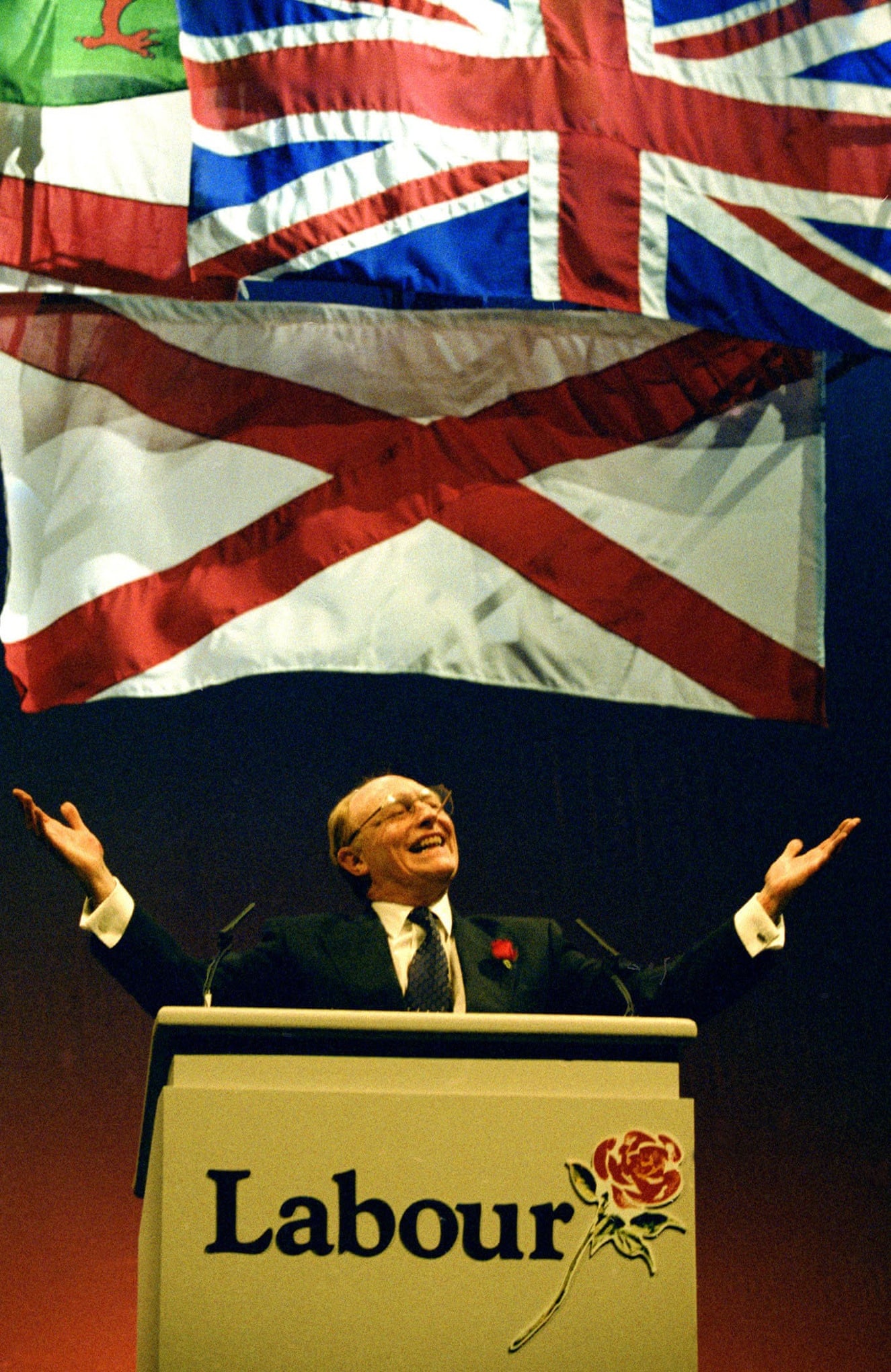
Labour Leader Neil Kinnock, 1992, Labour Election Rally


George Jones, Labour Leader - "An Absence of War", 2015

The play's vision considered prescient in speaking to not simply a political culture of media control, spin and contrived, consumer friendly image, it remains a potent indictment of the issues which have plagued the institution of British Labour for decades: press for a principled, orthodox vision of their political mission as compared to a new, right wing consensus which abandons the essence of social democracy in favor of electoral success. This argument more complex than the ostensible and time honored tugging between right and left, time has afforded the play an almost prophetic quality in that such questions still nibble at a Labour Party now at home with right wing narratives and a market society, but also in a cold indictment of a wider social narrative. As the ill fated George remarks, in a moment of impassioned indignation, it has become the nature of his party to indulge and pamper the sensibilities of a country too settled in media narratives, jingoism, consumerism and the affectations of great power status - and not challenge them, if he wishes to be elected.


Bounced between the political culture of early 1990's Britain and the institution of Labour's historic mission, we find a somewhat embattled and tragic figure: genuine and compelling, though ultimately a victim of not only the culture he wishes to better, but also his party and his own sense of history - a matrix which seems to lead him and his followers to their ultimate defeat.


"The Absence of War" by David Hare - 2015 Tour

Not overly well received when first debuted in 1993, the gripping intelligence and prescience of this dramatic work have since been proven fundamentally correct in their vision of a Britain comfortable in its conceit, a consumerist political culture of spin and the dissolution of a once vigorous, edifying movement into a business, not unlike their rivals. In the years since that first debut, the work's intellectual and ideological proposition have been found to have great traction in their subject - and especially in what Labour's ultimate mission is: that existential stinger which has so jabbed at the party for decades into the present day.


The essence of the play's power well proven, this rendition is a timely one: by no coincidence being toured in the weeks before a British election year of unique energy and issue as the Labour Party finds its mission again under scrutiny, and fragmenting in a world where it has less popular, obligatory traction than ever before.


In all, the play's powerful, potent indictments reflect something more singular: framed by the period of the early 1990's when the story was conceived, though given a more universal traction by the play's conclusion as a man - and his party - struggle to realize what their principles ultimately are, and how they could be worked in a world increasingly removed from their ideological provision: if this struggle is worth while or if some other form of recourse will be the movement's saving grace.


Justice, equality and prosperity remaining paramount to the vision of western democracy, it remains a cold, hard indictment of an age where growing extremes are met by increasingly vacuous, confined and ideologically deficient movements in modern politics - a state which the present Labour Party finds itself in, and which "The Absence of War" shines painful light upon, then and now.


Thank you,


Clark Caledon.