Saturday, 23 May 2015

Santa Barbara and Elliot Rodger: One Year On


Elliot Rodger


At the time of writing, it is one year since the tragic events on the evening of 23rd May, 2014, in Santa Barbara, California. Here, in the college district of Isla Vista, 22 year old Elliot Rodger embarked upon a lethal rampage which, despite its brief length, would ultimately leave seven dead - including the shooter - and a further fourteen others wounded. The events transpiring in May of 2014, I was moved to compose an essay in light of the eclectic and disparate attempts by numerous sources, groups and tendencies to explain shooter's actions, relative to the culmination of his plan - the pathetically self-aggrandized "Day of Retribution".


After due consideration, my own hypothesis as regards the troubled mind and life of Elliot Rodger proposed a cyclical model which saw his personality and emotional issues (Asperger's Syndrome/Autistic Disorder), collide with wider estimations of his social status and class which eventually mutated into mental illness - the psychosis which would stain Elliot's life for his last three, at least two, final years and which tempered his mentality to extreme ends. As I have said before, though I do believe that Asperger's Syndrome or an autistic condition was instrumental to Elliot's life, the spectrum of conditions does not, from the outset, incline those subject to them to violent or murderous behaviors, as suggested by the late Elliot Rodger: this something that must be reiterated as to ensure that such connotations do not - and can not - find root in the wider public debate, concerning these conditions.


My original essay on the subject of the Santa Barbara shootings and of Elliot Rodger's history and psychopathology can be found here on this same blog, from February of this year: 


Now, one year on since the shootings - drawn from the life of a singular person and which elicited a eclectic, often raucous and passionate social debate - perhaps the occasion calls for some reflection on where such issues now stand, since these events.


Image from Elliot's last video, overlaid with his manifesto words


As the debate centered upon Elliot's life and actions spiraled out in sweeping scope, I will frame my conclusions by reference to the three topics of my original essay - autistic ideation, social class and mental illness - before proffering a conclusion, of sorts.


In the first, considering the impact of Elliot's AS or autistic condition upon the wider narrative, there does seem to be a wider appreciation that Elliot's identity was informed by such personality and emotional factors, though not in such a way as to impel him to his deadly conclusions. This achieved on the part of wider understanding, representative groups and with a greater focus upon other factors, it remains that, in as far as I know, the incident moved little debate towards greater accommodation and a penetrative understanding of the role that autistic ideation did or did not play in Elliot's life. Some content to see the such things as just another aspect of an unprepossessing life or nature; other's considering still the importance of education in Elliot's life, had a more integrated regimen of instruction and discipline been given during his teenage years - something which, I feel too, could have given him a much wider perspective on life, and perhaps precluded his final descent in the last few years. Still, it remains to me to consider that the salience and wider appreciation of autism and of autistic conditions must be improved as to facilitate better education and integration; something more singularly progressive, as opposed to the stigma, negativity and denial which I have considered elsewhere in Elliot's life. 


Barbara Walters interviewing Peter Rodgers (Elliot's father) on the 20/20 show


As said beforehand, Elliot's social class is something of an irony, as it factors crucially into Elliot's egregious sense of entitlement, though it remains that his personal sub-culture of privilege is a sensitive subject for many to address. Of course, I am not denouncing meaningful, accomplished or tempered privilege, as said before in my essay, though I will reiterate that much of Elliot's world view was informed by a dull, leaden sense of privilege which he mused could be weighed against others - effacing his own insecurities and failings - while winning status and position among his peers, by virtue of social default. 


Of course, this was hardly ever the case and it both stung and perplexed Elliot all the more: this compounded by factors incongruous to his philosophy as he saw men of other races, and lesser social status, winning relationships with woman he believed should be reserving themselves for him. In some ways, there has been a guarded advance on this subject, and from different perspectives too. Critical sources analyzing and deconstructing this perspective, it is understood that Elliot's - and a wider culture's - understanding of privilege can be tempered by unsavory opinions about social status, entitlement and stratification: things that can, and have been, galvanized by numerous tendencies in society, and sometimes to very unpleasant ends.


 It is interesting and edifying to see this issue being addressed, and very much so, though it remains that a more thorough engagement with how privilege is embodied and understood is needed; more so, as to how privilege can be more constructively and actively tempered, relative to how wider society sees it in groups and individuals. A modicum of this critical sensibility may have helped Elliot to configure his situation in a different light, and perhaps even softened those dispositions which eventually coalesced into increasingly anachronistic prejudice and bigotry.


One of the final profiles of Elliot and the assorted responses to the shootings of 23rd May, 2014


Finally, there is the issue of mental illness, as it pertains not only to the crimes, but also to the final years and life of Elliot Rodger. In this regard, I have less optimism to reflect on, and rather a more dilute, tempered caution. In the year since the events in Santa Barbara, mental illness has become one of the principle elements so examined and spoken upon, as they pertain to the incident, though it has not garnered as much singular focus as other topics, so promoted by their patron groups - the case for racism, sexism and misogyny and negative masculinity all gathering particular followings, as opposed to the potent role played by mental illness in this whole, ugly affair. 


Though offered a considerable role, holistically speaking, the often undefined and sometimes nebulous nature of mental illness here has so often been effaced in favor of sometimes more classical or impassioned and less temperate explanations for Elliot's actions; these often espousing the primacy of their own focus at the expense of others, and of Elliot's psychopathology too. This lack of appreciation is unsettling, and more so when the very valid perspective is eschewed or denied in the face of more populist arguments which assert that one or more factors negate the influence mental illness played in this problem. In all, this is very troubling: doubly so when it is considered that Elliot's status in one or more groups - be they race, ethnicity, gender etc - precludes the serious consequences of having a mental illness that can result in far reaching social consequences, for themselves and for others. This finding somewhat disheartening, it remains a deficit and lingering problem for all and any groups attempting to appreciate the cause of Elliot's actions and the wider consequences thereof for the social complexion of mental illness, in western societies.


In conclusion, one year on from the 23rd of May, 2014, the legacy of Elliot Rodger's life and actions remain vital and important, if extremely disputed, fragmented and sometimes nebulous. The consequences of Elliot's actions working to indict many wider issues which made his crimes all the more sharply tempered and pernicious, it remains too that the narrative of the man's life - as it was so formed, colored and textured - was emblematic of both personal and social problems which so many others did not find to impugn - and even then in a mild tenor when it was increasingly beyond them to control the person Elliot could be becoming. The three factors I have postulated being, I feel, crucial to Elliot's path in life - and of his self-evident problems - the particular cycle and tightened conflation of these issues led to tragedy, and after that, his ultimate end by taking his own life. 


The subject widely entertained and often heated, the Santa Barbara incident with Elliot Rodger remains a potent, and all to singular compound of problems which could have been worked against - perhaps entirely avoided - if other factors prevailed and better decisions were made. In the end, it must be for a culture, a society and a people to learn from its mistakes and evolve towards a better tomorrow: an edifying process which is often pained and long, though which works towards a bettered social whole. In the time since, it is good to hear, from some sources, that the town of Santa Barbara and the college district of Isla Vista has become a little more civic minded and caring of its eclectic community; a disposition which I hope will remain and evolve for the good of all there. A disposition which I too hope other civic and similar bodies may learn from in precluding serious social problems, in the years to come.


Thank you,


Clark Caledon.

Friday, 8 May 2015

UK General Election 2015: The Day After - Controversy, Constitution and... Maggie Simpson?


Hi there,


In Britain today there is a rich, sometimes awed mingling of reactions to what has been an extraordinary night, in our constitutional history. Labour's implosion in England and particularly in Scotland, compounded by the disintegration of the Lib Dems and a strong, but limited showing from Ukip and Conservative effort has returned David Cameron, now with a majority of 331 seats, to the premiership.


In a day of remarkable drama, dashed and enlivened hopes, Britain now is compelled to carefully consider, after the passions of election, the future it faces.


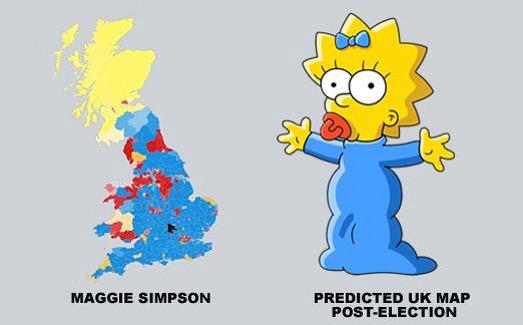
Though we will consider the respective factors further, the electoral map below - displaying Westminster constituencies contested in 2015 - embodies the stark, imposing reality of the new political alignment in the UK. The SNP the great victor of the night, they have swept to power across Scottish constituencies once considered Labour and Lib Dem bastions. Winning an astonishing 56 of the nations's 59 seats with a general swing of 25-26% from Lab to SNP, all that remains of the other parties in Scotland follows succinctly: the rural borders of Dumfriesshire held by the Conservatives, metropolitan Edinburgh South held by a combination of Lab and Conservative support in a Labour Candidate, and the islands of Orkney and Shetland, narrowly retained by a decimated Liberal Democrat party. But, in England, the wider narrative played out to the confusion of pollsters, voters and parties alike...


Westminster constituencies election 2015 results - Scotland, England, Northern Ireland & Wales (image courtesy of BBC election night coverage)


South of the Scottish border, the electoral environment was hostile, convoluted and witness to remarkable moments in British electoral history. The Conservative Party mounted a confident campaign against their rivals, while Labour strode towards the election with some measure of confidence: aspirations of forming the next government indulged before hopes were dashed as the political dynamics England proffered gave eclectic results.


The Conservatives doing well, as did Labour, at the cost of a withering Liberal Democrat vote, Labour failed to find traction in the south, beyond their bastions in the midlands and in the north; these being taken by conservatives who also gave a strong showing in Wales where - astonishingly - Labour lost their bastion of Gower: loyal for over a century before being captured with just 27 votes for the Conservative candidate. Elsewhere, the demise of the Lib Dems - seen as part of the necessary process of restoring a Labour government - was compounded by Ukip drawing Labour support away, and ultimately attenuating efforts in many regions where Labour hoped for a breakthrough.


The controversial party of the right, Ukip followed in second or third place where Labour and the Conservatives fought, with their influence felt in many instances where thousands drew away from red, blue and yellow to support the purple pound of the arch euro skeptics. Conservative success at the expense of Labour, Lab's gains from the Lib Dems and Ukip frustrating the efforts of both the former two was a scenario played out in many key constituencies which - along with SNP victory in Scotland - resulted in a growing complexion which one canny twitter user remarked was rather like the infant Maggie Simpson of "The Simpson's" fame. A note worthy of a chortle or two...


UK 2015 Post-General Election Map & Maggie Simpson (Uncanny)


By hours of daybreak, the future was looking bleak for Labour, disappointing for Ukip and atrocious for the Lib Dems; a once vigorous parliamentary party of 57 reduced to 8 in less than a day, memories of government growing distant as obscurity beckoned. The Conservatives returned with a majority of 331, Labour suffered a retreat of its fortunes not seen since the defeat of 1992 (the recent rendition of the play "The Absence of War" seeming darkly portentous, concerning the election), under Neil Kinnock; polling data, now having proved so despairingly aberrant, once evidence of a neck and neck race, now latently pointing to a decisive Labour decline, as exit polls contradicted their predecessors. Labour reduced to 232 seats, while their Lib Dem competitors retain only 8 seats - equal to the Northern Irish DUP -  their respective leaders sought immediate resignation; words bracing for a difficult future as both parties are destined to struggle in hopes of explaining their defeat - and to rebuild, come what may. The same was said of Ukip - the controversial Nigel Farage failing to win his seat as the party's role seemed more of a strategic hinderance than destined legislative force at this election, though now entering the House of Commons with one seat.

Resigned Party Leaders - 2015
Ed Miliband (Labour), Nick Clegg (Lib Dem), Nigel Farage (Ukip)


At the conclusion of this general election, a singular electoral experience, we arrive now at the threshold of a new paradigm in British politics. The Conservative Party seemingly victorious, David Cameron cannot afford to be indulgent with his second term: lacking a Scottish or wider British mandate while also facing a Conservative party galvanized by euro skepticism and the draw of social politics which could yet prove very difficult for wider British society to stomach, in the long term. More so, the SNP's victory in Scotland has compelled the astonishing understanding that Cameron may very well be the last Prime Minister of the UK, in its current constitutional complexion: Scotland's devolution set to grow and evolve into greater autonomy regardless of what some in the Conservative Party may consider of their northern neighbor. 


In addition, Labour heads to not only a leadership contest but to also a potential indictment of the party's governing social and political paradigm: the neo-liberalism of the 1990's and 2000's working to alienate voters, while a weaker stance on ethnic and social politics has undermined the party in some English seats of a increasingly conservative voting culture - a stance which Ukip capitalized upon to severely maul both Labour and the Lib Dems. The Lib Dems having been decimated, their future as a viable political force remains uncertain as the liberal tradition in present day England seems to be winding down to historical obscurity. Ukip, once hailed as the party to upset the establishment, were ultimately constrained and limited to one seat; their destined success seeming less surely purchased as their narrative corroded both Lab, Lib Dem and Conservative support without actually breaking through themselves. 


With the election now over, we have seen a remarkable few months come to a close as another, and possibly exceptional, chapter in British politics begins; Britain potentially realigning under a more articulated or heterogeneous federalism with the once linear politics of the Westminster paradigm fragmenting into more overtly ethnic, delineated models of democracy in the respective polities.


Wither such postulations come to pass, or if the UK has a future within a reconstituted, deeply reformed framework is debatable, though it will remain from this day onward that British politics - now and for many, many years to come - will never be the same again.


Clark Caledon.


Thursday, 7 May 2015

UK General Election 2015 - Election Day


Hi there,


In the second part of our UK election special, having introduced the principal parties, players and issues on the 6th of May, we now find ourselves at election day itself: polling centers opening across Britain early in the morning and closing at 10 pm tonight to allow voting for the relevant Westminster parliament constituency. What may come of these local battles will not only determine the complexion of the future parliament that will emerge tomorrow, 8th of May, but will also be but the first motion in the power play that is to follow: the complexion of any government - if there is no decisive victor - decided through coalitions, partnerships or wider constellations between the parties of a new parliament, which promises to be controversial and potently eclectic.


Polling Day in 650 UK Constituencies to determine the next Westminster Parliament


At the time of writing, just past eight o'clock in the evening, voting has been ongoing since seven in the morning, and now with just over an hour to go before polls close. After this, counting will begin in regional centers; the total votes cast allocated to those standing, after which will emerge a winner by the end. There is no exact time table for this, but it is known that Scotland will begin processing votes promptly with a good many constituencies declaring before three o'clock on the 8th of May, around six hours from now. From a while, before and after that, English and Welsh constituencies will begin declaring their results, as will Northern Ireland too. The last declarations will probably be around seven the following morning, though by that time electoral scenarios will probably have played out - positively or negatively - and a new government will be forming soon thereafter.


In this case, hung parliaments and coalitions now very much a recognized avenue of electoral politics, it remains that though a result similar to the 2010 election could be played out, the mainstream parties are now very much tested in their opinions and the infusion of much larger national, regional and special interest contingents (ie. SNP, Ukip, Green etc) will make the business of discerning a mandate more complicated. To this end, and for some months, a number of scenarios have been postulated, depending upon the resultant complexion of the electoral map come the early hours of May the 8th. This new plural parliament and its more negotiated mandate will succeed, in most part, the election of 2010: an event which saw the then odd situation of a hung parliament and with no decisive mandate for either Conservative or Labour, without a third or more parties aligning. Received with an air of controversy and still debated today, the election of 2010 could very well have prefigured many British-Westminster elections to come - in their candor and complexion - though if this is a compliment or indictment of the Westminster system, it remains to be seen...


The electoral map of the 2010 Westminster elections can be found below, with metropolitan regions of particular significance highlighted. Though the dynamics played out with some predictable direction - Labour deciding in metropolitan regions, Conservatives in the rural shires and Lib Dems a mingling of both with other parties performing to their own imperatives - it remained that neither Labour, Conservative or Lib Dem could sufficiently color the map to control the House of Commons, and thus form a government, without co-operation with another.

Map courtesy of Wereon on Wikipedia - image in the public domain.

2010 United Kingdom Electoral Map - Westminster Constituencies (Central Scotland, English Midlands and London highlighted)


This day playing host to a number of evolving socio-political narratives, imperatives and tendencies, local contests will have an accentuated significance, especially in the so called celtic periphery of Britain, while Labour, Conservative and Lib Dem will have a severe strain to press their support, wherever and whenever they find it, to supply MP's for their respective parties.


A remarkable election locally and nationally, in the four nations and in the British whole, what transpires in the next 24 hours will be interesting to consider; an emerging politics in motion, or perhaps a new configuration of British identities, in the decades after devolution, the financial crises, austerity culture and the dilution of a once presumed, singular mandate.


Time will tell, it seems...


Clark Caledon.

Wednesday, 6 May 2015

UK General Election 2015 - The Day Before


Hi there,


Today and the two that follow it will prove particularly interesting in my corner of the world. In the very least, we stand on the threshold of a general election for the United Kingdom's central legislature - the Westminster Parliament - and the further examination of Britain's democratic culture in the years after the financial crises, but also an event in which the dynamics are thoroughly unique. By nature a majoritarian, first-past-the-post system, usually dominated by the Conservative and Labour parties - latterly with the ostensibly centrist Liberal Democrats as the former's government partners - this election is one in which the central institutions of the British political system have been subjected to growing peripheral examination from nationalist, regional and special interest parties, working in the face of the centre's perceived deficits.


Over the last five years, we have seen many new and remarkable developments in British politics and in the tenor of the prevailing discourse: no longer as singular or as predictable as it once was, and with the marked growth of national, ethnic and social narratives pointedly removed from the once prevailing mainstream. Certainly deriving from events before the assumption of the Conservative-Lib Dem Coalition in 2010, it remains an indelible fact that government in Britain from this point onward has proven one galvanized by attempts to address the financial crisis of the late 2000's, but also the enduring legacy of that era has impelled many in the wider British polity to consider their world more critically. Now, on the eve of what must surely be something of a judgement concerning these past years - and the more complicated, charged ambiance they afford - it remains to consider what might become of the hours and days ahead.


Of course, there are a number of scenarios - with markedly more gravitas since coalition government became a fact and hung parliaments a feasible fixture of the new politics - and though some have more purchase than others, it does afford many intriguing possibilities for the future of governance in Britain.


Of the three ostensibly principle British parties - Labour, Conservative and Liberal Democrat (the latter no longer the third largest) - the former two still indulge dreams of a majority, while the latter would wish to inform and partner with the one bearing the firmer mandate. The polls to date reading as almost parallel between Labour and Conservative, the Lib Dems have made good on their obligation to give at least a brave front: no other choice prevailing in the face of their unpopularity and seemingly constrained profile in government.


The Labour Rose, Liberal Dove and Conservative Oak


In turn, as the focus and momentum has drawn away from the centre, we find the parties embodying this tendency: some new, some established and some refreshed by new, regional debate. The Scottish National Party have compelled a remarkable profile over the past few years. Winning a majoritarian style second term in Scotland's 2012 devolved elections, the party's fortunes were staked high for the Scottish independence referendum of 2014. Though ostensibly defeated, the party - having since become the focus of a wider, vibrant constitutional movement - experienced a surge in growth: passing 100,000 members to eclipse the Lib Dems as Britain's third largest party overall, and compelling a critical examination of Scotland's expanding powers of devolution as the Scottish and British polity's grow wider in their disjunction. Considering the possibility of them eclipsing Labour in Scotland's Westminster constituencies, they have been regarded - with some disdained fascination - as potential kingmakers to a future Labour government, if Labour can compromise towards a common, progressive imperative and does not win a majority.


 Stylised Saltire of the SNP


Considered to something of a ideological counterpoint to the aspirations and influence of the Scottish nationalists, is the resurgence of the seemingly ironic and English phenomenon of Ukip: the United Kingdom Independence Party. The group springing from obscurity as voters found a common voice in the party's euro skepticism, fears over immigration and affinity for ethnic conservatism - if it can be called that - across portions of rural and semi-urban/urban England. Wales, Scotland and Northern Ireland offering the party little traction, they remain a seemingly popular force in their heartlands; intruding between the narratives of Labour, Conservative and Lib Dem with efforts to synthesize a more reactionary, hardened conservative stance in Britain more widely. Ambitious, it remains to be seen if this party can stand the test of a general election.


The Purple Pound of Ukip


Two other parties that could prove influential, in the coming contest, arrive from very disparate backgrounds, but could prove interesting actors, should they arrive in some contingent at Westminster. Firmly unionist and socially conservative, the Northern Irish Democratic Unionist Party has stood in opposition to growing regionalism and nationalism, but their leadership has been critical of the mainstream's disdain for the legitimacy of Scotland's growing democratic will and the potential influence of SNP MP's. This stance questioning potential deference to the Conservative or Labour Parties in a hung parliament or minority government, their decisions could be interesting.


The DUP Lion


Another party, very much removed from the former which could prove influential is the moderate, progressive and increasingly successful force of the Green Party. Originally a party proposing a middle way between social and economic imperatives, with environmental sustainability considered critical to both, this group has proven to be a honed and compelling political voice. Though not always as singular or as socially driven as some of the other parties who promote a more established philosophy, the Green's could yet prove a factor in turning government in Britain one way or the other, depending upon the nascent narrative of the other parties. Still, if lent to a strong, progressive mandate in parliament, this group might very well find their long awaited national breakthrough, since their inception.


The Leaf Corona and Earth crest of the Green Party


With these words and perspectives in mind, the rapidly approaching election day and what succeeds it could prove for a very, very intriguing 48 hours.


Clark Caledon.

Saturday, 25 April 2015

The Absence of War: A Play by David Hare


Hello there,


One of the principle elements of politics - perhaps always - is the extent to which principle itself determines action, as contrasted with the pull and temptation of joining a wider consensus, or at least what can be perceived as such. The crux of a dilemma within the progressive, social democratic tradition of European and American politics for decades, this issue - itself pregnant with an existential challenge - was explored with potent candor in the British political drama of 1993, "The Absence of War", by David Hare, which I happened to see an new rendition of in early April of this year.


A taste of the play's ambiance and vision can be found below, in its official trailer for 2015.


The Absence of War - 2015


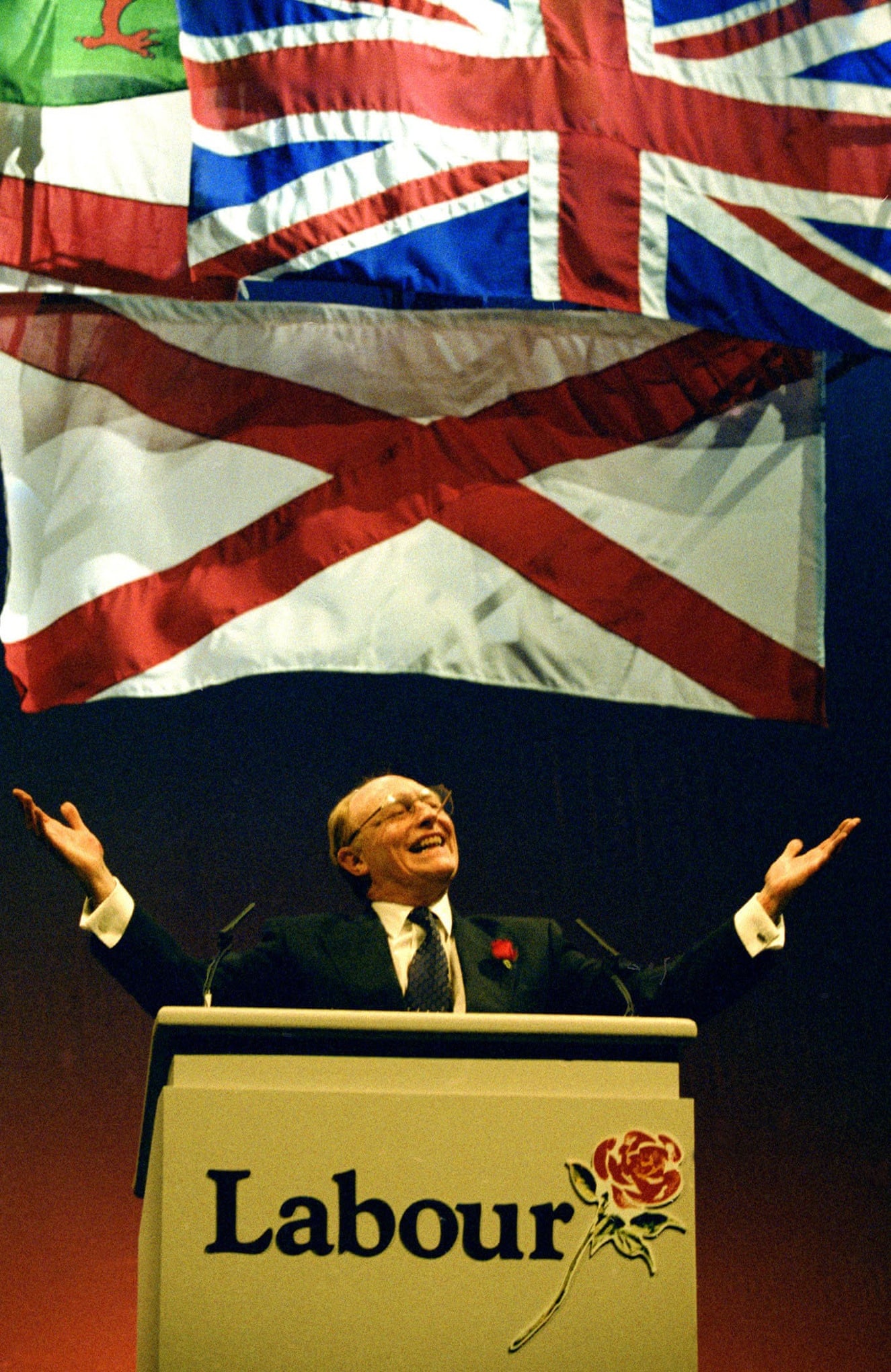
The play is drawn from the remarkable, congested failure of the pre-Blair British Labour Party to win the general election of 1992: an event often considered as "old" Labour's last chance at electoral success before the rise of the neo-liberal faction within their party to prominence in the early 1990's.


The play set itself to examine such questions and challenges with a vivid candor - introducing the charismatic, successful Labour leader of George Jones in the face of a waning Conservative government, and the personal world of the party's executive ranks which would determine so much of the election to come. George Jones is himself a singular, rugged and compelling leader, though his leadership is the fount of considerable ambivalence between his measured modernization, his detractors within the party and the perceptions of a British public now resolved in a reactionary, right wing mentality after a decade of Thatcherism. His task indelible, the cluttered imperatives, congested principles and quiet convulsions of his political world converge to choke his ideals: the result a increasingly fractious slide towards defeat - mirroring the initial optimism and drive of the 1992 campaign before it dispersed under similar circumstances.


Labour Leader Neil Kinnock, 1992, Labour Election Rally


George Jones, Labour Leader - "An Absence of War", 2015

The play's vision considered prescient in speaking to not simply a political culture of media control, spin and contrived, consumer friendly image, it remains a potent indictment of the issues which have plagued the institution of British Labour for decades: press for a principled, orthodox vision of their political mission as compared to a new, right wing consensus which abandons the essence of social democracy in favor of electoral success. This argument more complex than the ostensible and time honored tugging between right and left, time has afforded the play an almost prophetic quality in that such questions still nibble at a Labour Party now at home with right wing narratives and a market society, but also in a cold indictment of a wider social narrative. As the ill fated George remarks, in a moment of impassioned indignation, it has become the nature of his party to indulge and pamper the sensibilities of a country too settled in media narratives, jingoism, consumerism and the affectations of great power status - and not challenge them, if he wishes to be elected.


Bounced between the political culture of early 1990's Britain and the institution of Labour's historic mission, we find a somewhat embattled and tragic figure: genuine and compelling, though ultimately a victim of not only the culture he wishes to better, but also his party and his own sense of history - a matrix which seems to lead him and his followers to their ultimate defeat.


"The Absence of War" by David Hare - 2015 Tour

Not overly well received when first debuted in 1993, the gripping intelligence and prescience of this dramatic work have since been proven fundamentally correct in their vision of a Britain comfortable in its conceit, a consumerist political culture of spin and the dissolution of a once vigorous, edifying movement into a business, not unlike their rivals. In the years since that first debut, the work's intellectual and ideological proposition have been found to have great traction in their subject - and especially in what Labour's ultimate mission is: that existential stinger which has so jabbed at the party for decades into the present day.


The essence of the play's power well proven, this rendition is a timely one: by no coincidence being toured in the weeks before a British election year of unique energy and issue as the Labour Party finds its mission again under scrutiny, and fragmenting in a world where it has less popular, obligatory traction than ever before.


In all, the play's powerful, potent indictments reflect something more singular: framed by the period of the early 1990's when the story was conceived, though given a more universal traction by the play's conclusion as a man - and his party - struggle to realize what their principles ultimately are, and how they could be worked in a world increasingly removed from their ideological provision: if this struggle is worth while or if some other form of recourse will be the movement's saving grace.


Justice, equality and prosperity remaining paramount to the vision of western democracy, it remains a cold, hard indictment of an age where growing extremes are met by increasingly vacuous, confined and ideologically deficient movements in modern politics - a state which the present Labour Party finds itself in, and which "The Absence of War" shines painful light upon, then and now.


Thank you,


Clark Caledon.


Monday, 9 March 2015

Spoken Word Poetry: Pick & Mix


Gaius Lucilius (180 - 103 BC) - Father of Satire


It can't be denied that words have a very particular, a very singular quality to them - a remarkable power which, in the hands and minds of the adept, become something extraordinary to behold; and even more, to consider after the fact.


When given to a impelling motion, or embodied in a poet's voice, words can seem even more vigorous and potent; the power to conjure and evoke so keenly in the mind of the reader or audience, as a new vista is opened, sometimes willingly or not. This potency is given sharp relief when, as is so often the case, art is used to chastise or reproach the social body or elements of its culture. Though a debatable figure in some circles, Germaine Greer - speaking in Sydney in 2008 - relates this power with compelling cadence; particularly recalling John Dryden's translations of the Roman satirist, Juvenal, and the urge to articulate all he found objectionable in others and their places.


Germaine Greer: Keynote address, Sydney 2008-"Rage in Achieving Social Change" (Part 2)


Poetry has been a part of my life for some considerable time, though the happy confluence of YouTube and the popularity of spoken word art invigorated my interests; this compounded by a difficult period of my life between 2010 and 2012 which was brought into compelling relief by the eclectic array of works I found.


Since the period, I have entertained a interest in spoken word poetry; embodied to great effect in the Slam poetry sub-culture which has experienced so much of a renaissance in the United States through online mediums and better dissemination overall. Considering this with interest, I mused on a brief compilation of some works which I found particularly interesting, or which had a singular quality in the tenor of their subject - a sometimes thoroughly eclectic mix of social issues, race, sexuality, gender, class, language, culture, ethnicity, personhood and social identity.


It's my pleasure to have finally acted on that idea, and to bring a selection of ten such poems - realized through the candor of their respective authors, and with some brief analysis to situate their impact when I consider them.


1) Karen Finneyfrock - "Newer Colossus"


An incisive, poignant reflection on the legacy of promise - or perhaps a promise broken? The poet draws her inspiration for that most singular of monuments in the Statue of Liberty; the titular "newer colossus" by whose lamp is illuminated an America deeply changed from its more idealistic origins - and with particular regards to what becomes when human value is so often subordinated to untempered, material profit.


2) Kait Rokowski - "New Insults"


Forthright and convinced, Kait proposes a series of new, inventive insults as the aggrieved party in a former relationship, perhaps. Potent and with a vivid texture, her words bring anger to the fore creatively. Though, it remains that this work has its rightful detractors and critics on the sometimes nebulous purpose of the poem. Angry and remonstrant in hurt, it remains that relationships can rarely be taken on the account of one party - and more so when break ups are involved. To this end, it remains for us to ponder all that is and will not be said, for better or worse, while the other party is not present and the poet steers an ardent course towards her own conclusions.


3) Michael Lee - "The Addict, A Magician"


Vivid and visceral, this poem explores - neigh, impels a cold consideration of an addict's mentality: reflections on the the emotional drive and the relationships which evolve around lives subsumed by substance abuse. The essence of the work will speak with a visceral condor to those that have witnessed or experienced drug abuse of this sort; the dedicated, pathological mentality with which the ill will persevere in their behavior, even to the point of death. On a final note, the poignancy is compounded in that the death of a friend to addiction can be a startling revelation to those that survive them, impelling their hopeful recovery.


4) Lilly Myers - "Shrinking Women"


Families are complex things, and most certainly when it comes to the nature of gender relations; or simply the nature of primacy, beyond any considerations of gender. The poet speaks to the often ingrained and deeply absorbed qualities which perpetuate through families, promoting problems through the generations in which - as per the occasion of this poem - women haunt themselves with doubt while men are taught to be bold and assured of their own position, unwitting of their own conceit. A poem that speaks to ethnic history, gender relations, tradition, social identity and the foundation of familial issues that so often work to drive families apart, than compounded their solidarity.


5) Andrea Gibson - "Wal-Mart" 

(lyrics) http://inventloveani.livejournal.com/29784.html  Download Amazon http://www.amazon.com/Walmart-live/dp/B00129DPCS


A potent, powerful rhetorical drama, Andrea Gibson's work arrives here with a distinction. Though popular online, the poet has seen fit to have online recordings removed, thus I would proffer the lyrics above, with a version available on Amazon.com. "Wal-Mart" is singularly potent in its indictment of reactionary, institutionalized bigotry and the traction of so many conservative, traditionalist attitudes towards social identity - often unchallenged and only finely tempered in the perennial debates on social values in America.


6) Hieu Ngyuen - "Buffet Etiquette"


Speaking to the often felt unease over ethnic history, identity and cultural equilibrium felt by some in America, Hieu's grounded words compel poignant appreciation of what it means to be more incorporated into a culture, more removed from your parent's own. His words inspired and rugged in their candor, this work is something that can be open to numerous kinds of interpretation; discernment necessary to unfold the very personal heart of the issue.


7) Kelly Tsai - "Mao"


First performed circa. 2003, this powerful work performs an ostensible indictment of some so called counter cultural or popular movements: needling the sometimes unwitting, problematic conceits of groups who, being less an incisive critique of their counters, are sometimes simply equal, opposite reactions to them. Considering issues of social identity, transmission of ideas and culture as well as indoctrination, Kelly's critique is somewhat portentous of what would follow in the successive decade as she keenly eyes movements which become distracted from their cause, in favor of promoting their own orthodoxy and discipline while denying even helpful others.


8) Carly Brown - "Straight" 

Unfortunately, as there are uploading difficulties with this particular reading, please find a link to YouTube directly here http://youtu.be/sX1EcCgfXCw .


Speaking to the homogenization of history, and its role in the wider human experience, Carly seeks to embody the often incongruous tendencies seen in conflicting narratives, which fuel either or. In the first we find the yearning to understand and tabulate; this tendency promoted as being congruent with such qualities as patriotism, nationalism, ideology or any other well defined set of social prescriptions. Conversely, we have the notion - so embodied in post-modernist thinking - that modernist definitions and ideas have fragmented; hence forth, promoting a myriad of incongruous and contradictory experiences which can seem disruptive to any systemic understanding of history - our own, or another's. The conclusion is found in contradiction as, contrary to her words, we can't just stop in our narrative, as it may be.


9) Suheir Hammad - "Not your erotic, Not your exotic"


A work by Suheir Hammad, circa. 2003, we find a cool deconstruction of ethnic identities which can sometimes be seen to be confined in sexual spaces, in the eyes of some men, along with other implications too. Founded in well meaning, strength and a vigorous conviction, so much of its potential power is lost to a linear end. As an indictment of racism, social attitudes and confined perceptions - particularly prevalent, given the circumstances of the early 2000's - it works well, but its direction works to be more divisive, than conciliatory; a singular effort which doesn't appreciate the wider human or social narrative in the subject discussed, and thus comes across as insular and potentially myopic.


10) Maya Wegerif - "Why you Talk so White?" 


Rounding off my selection, Maya speaks to the fundamental power of language to both constitute and reflect reality; the discursive content of everyday life sometimes working to define, exclude, stratify, control and divide. The notion that language can define identity is a potent one, and very much so explored in Maya's anecdotal account, though it remains that the dynamic is often seen among under or lower classes in the mistaken pursuit of solidarity or integrity - a self-perpetuating cycle which is less frequently helpful, than it is confining. A eloquent, concise and intellectually singular work which recommends about the constitution of social identity through language.


Here ends my selection of spoken word poems, and I hope it has left you with a richer, keener insight into the power of not simply language, but of both the rhetorical art and what it can achieve, in aid of social critique.


Thank you,


Clark Caledon.


10/03/2015

Thursday, 19 February 2015

Elliot Rodger: An Essay on Cause


Elliot Rodger -  From final Youtube video prior to the shootings


At the time of writing it is the best part of a year since the tragic events of 23rd May 2014 in Santa Barbara, California - a day which saw the deaths of six and the wounding of thirteen others, along with the shooter's suicide. The perpetrator was 22 year old Elliot Rodger, a former local college student, who contrived a killing rampage - his deeply self-aggrandizing "Day of Retribution" - in seeming response to many years of alienation, sexual rejection and wider social frustrations.


As the events which so shocked and appalled have passed into recent history, the legacy this singular event engendered has come to be a divisive and deeply emotive one. Beyond the discussions of gun culture and its related violence in the United States, the shooting precipitated a, often vociferous, debate between groups concerned with the mediation of gender identity. Many groups, often drawing from feminist discourse, seeing in Elliot a reflection of a systemic misogyny, while the counter to this was framed by a less cohesive, but none the less valid, constellation of concerns; seeking to not overlook, but diffuse the assertions of singular misogyny into other causes, without the seemingly clumsy indictment of masculinity as a whole.


The reception and dissemination of Elliot's actions nearly unprecedented in the history of such events - ascribed to his self-documentation in social media and authorship of a manifesto - but also in the eclectic spectrum of analysis that followed in global and national media, social media and sundry online sources. In the months that followed, the topic of Elliot's actions, their cause and ultimate legacy, was saturated with analysis that was exceptionally diverse in focus, inflection and conclusion: it seeming that no rocks have yet to be turned over in trying to understand Elliot's rationale.


Police conference on the identity and weapons used by the shooter

Coming to myself, and my own contribution, please know that I wholly appreciate the sensitivities surrounding the singular nature of these events, and it's not my intention of aggravate old wounds. But, as the events that culminated in the shootings may, in some part, remain nebulous and open to speculation, it remains of some importance that a case as singular Elliot Rodger's is not overlooked, but framed in the right way as to inform and color future receptions of nascent social problems, violence and mental illness. Insight, no matter how incremental, is essential in this respect, and it's here that I find my rationale for offering an analysis of the events and issues which preceded the shooter's actions, not necessarily the reception beyond these, as has been seen in some quarters of social media and its associated sub-cultures.


As to allow for relatively good digestion of these issues, and to hopefully preclude intemperate suggestions of pandering to one side or another, I would like to proffer a statement of orientation: a essential, uncomplicated premise which will inform this article, as it goes. It is as follows.


Elliot Rodger was a man who drew from particular developmental and social circumstances; these becoming factors - though not completely causal or instrumental -  in the expression of serious mental illness, which he unfortunately developed before his crimes.


It is with this perspective in mind that we move to a consideration of those factors, or perhaps dynamics, which would seemingly result in the shooter's actions that day. To this end, I have envisioned three cardinal elements which I hypothesize gave some definition to Elliot's circumstances, and the final spiral which would end with his actions on the night of 23rd May, 2014.


In some ways, I envision this as a triangular formation, within which can be located the intermingling of issues and problems which evolved during the scope of Elliot's life. Though I don't wish to seem misrepresentative or arbitrary, I have chosen the points that follow to be rationalized into a rudimentary chronology, I feel giving the best meaning to the developing person that Elliot would emerge as.


1) Asperger's Syndrome & Developmental Issues


As analysis of Elliot's actions and words got underway, it would emerge and remain that Elliot's life was informed by developmental impediments and problematic ideation: emotional sensitivity, temperamental reactions, reasoning deficits for his successive ages and an array of otherwise noted issues that Elliot felt himself - albeit numbly as his psychosis progressed - and through other sources, as with his parents, peers and sundry authorities.


Though it remains debatable as to if Elliot ever received a formal diagnosis - his father asserting that he did not - it remains ostensibly self-evident that Elliot's development was colored by such problems.


Of course it must be reiterated with the utmost sincerity that Asperger's syndrome, or any other Autistic condition, does not simply predispose a person towards such actions as immediate violence, sudden crime or homicide. This statement cannot be expressed enough as to ensure that such individuals are not misrepresented or mistreated for being as they are.


Carrying on, if the tenor of Elliot's life and world view were textured by autistic development, then it would perhaps fall to his parents, family and educators to best discern his needs and determine developmental imperatives. Did this happen, though? It remains debatable. It is known that Elliot was seen by a intermittent succession of counselors, therapists and other persons from the age of eight onward, but any positive legacy they effected seems muted at this time. Though I don't doubt that they worked as they could, it remains that the lack of a central diagnosis for such rooted behavior does handicap to a point; the varied lengths of time between referral and the problems reported to them giving little in the way of a coherent foundation with which to begin treatment. In the end, it could be postulated that the best they could afford Elliot's mounting profile was to treat the symptom they found, and cushion the excess of his behavior within their competency.


This approach elected by his parents generates the understanding that though Elliot's family appreciated the potential of Elliot's problematic behavior - employing therapists - his secondary education was fragmentary; Elliot manifesting difficult behavior which saw him rotate through a few schools before eventually graduating from a school for the troubled or developmentally difficult called "Independence High". This recognition - albeit not singular - of Elliot's issue seems to have become more sporadic when his mandated education ended: their son continuing to see counselors and life coaches, though Elliot's experience of college life was fundamentally stunted by his seemingly unresolved habits and lack of social vocabulary or maturity.


Elliot's final years would see him eventually dropping college in favor of other pursuits which would only reinforce his mentality - through their lack success - and compound a sense of finality, which he had neither the insight, emotional reflexivity or wider ability to try and resolve. Though, perhaps it didn't have to be this way, as regards those first developmental challenges.


In all, I have no doubt that raising a child with developmental challenges can be arduous, though regardless as to the ultimate success of parenting, it remains that parents subscribe to a certain social narrative: a text of apportioned values which some, especially in higher or sensitive positions, might find constraining, distracting or disproportionate to their wider responsibilities. Accepting a diagnosis can be the beginning of this - the formality of openly having an autistic child, or a child with associated problems, and thus can be deeply unwelcome in what it alludes to for the years ahead. Still, beyond these, it remains that some will resist and deny a diagnosis out of love and insist on something else, to their wider detriment in the end.


I don't doubt that Elliot's parents and carers tried as they saw best, though it remains that much of this consensus did little to make their positions any easier, to afford insight and even to preclude the tragedy that followed. With retrospect, perhaps it could have been hoped that a formal diagnosis of something substantial in Elliot's character would have interrupted the fateful build to his self-imposed, miserable last years, and more importantly saved many others from death and injury too.


If Elliot did have Asperger's Syndrome, or some associated problem, successful treatment and cultivation of better qualities would have started with a more coherent recognition, planning and the promotion of a better mentality with which to build a life. It being that AS, and anything else, were not overly entertained, it prompts speculation as to what, if anything singular, his parents or other authorities imagined they were dealing with in such severity, and why his habits didn't merit deeper intervention years before.


2) Social Status & Privilege


"Money talks, but it don't sing and dance, and it don't walk."

                                                                                                      - Neil Diamond, 1979


The first line of the song "Forever in Blue Jeans", by Neil Diamond, has since passed into popular culture as a well heeded, but only arduously observed maxim. Money does, as the song asserts, talk - but it can't truly instill nor is it spontaneous and its character is only as it comes to you. To an even tempered mind this would be pragmatically understood, but to Elliot Rodger, his seeming privilege- understood or alluded to - afforded him a status which he believed would propel him to success, almost as a natural law of the world around him. The irony of what transpires as his life unfolded - and especially in those last few years - would have been bitter and strange to the future shooter.


The nature and reception of privilege a deeply contended one, I must assert sincerely that privilege is not in itself a bad thing. But, privilege is rarely without wider constructions, and if not tempered or finely expressed, it can become a fount of much difficulty, and the justifiable pretext for much protest and redress.


The question of Elliot's status and the privileges he benefited from for much of his life well documented, it remains that this singular issue has become one of the most bitterly debated subjects amid the shooter's motivations. As aforementioned, some frame his privilege as being the belief that he was entitled to women - the misogyny so powerfully indicted by some commentators - and that his mounting, lethal impulse followed rejection by them. This perspective a potent one, its emotive power can be appreciated in the concise, vivid poetry of Anna Binkovitz in her work "For Elliot Rodger", as rendered at the CAMP BAR, Saint Paul, Minnesota on February 13th, 2015.


                                          "For Elliot Rodger" by Anna Binkovitz, 2015


As powerful a factor misogyny can be, I am inclined to disagree with the singular assertion, regarding Elliot Rodger's actions. Misogyny, taken within the wider phenomenology of Elliot's experience - both subjectively and from other credible sources - is an expression of Elliot's issue, not the principle. Though, of course, it must be said that other such questions were propelled at the case, and particularly in regards to Elliot's racism - his contempt for other races, peoples of mixed heritage and especially Asians - do inform, as does misogyny, part of his world view. This is again a manifestation of something more intrinsic. Additionally, the questions relating to his masculinity - something which compounds issues of misogyny and racism - can be found to derive from understandings of status; not simply associated with the whiteness in his identity, but from a wider class association. And, particularly, what he believed that to entail.


Elliot's account of his life, as self-obsessed and unsavory as the document may be, does work to shine light on a topic that has received little attention in the wider debate; perhaps being conflated with other issues, or being too pointed to evoke, when compared to more direct narratives. In this, we find that Elliot's sexism, misogyny, racism and nascent narcissism are examined, though what of his classism?


A reading of Elliot's account will leave little doubt as to the esteemed position he believed to be his; this quality not simply a stamp of narcissistic delusion, but Elliot's own reading of the values and culture he considered to be his natural estate - albeit one remarkably skewed and blunted. To Elliot, the internalization of such a narrative would promote the projection of certain norms, as he saw them, and with particular regards to masculinity, materialism and the vindication of this, ostensibly, feted status through sexuality. Of course, much of this narrative sadly holds true in particular parts today, but Elliot's opinion would devolve even this dubious understanding of the world; his particularly brittle perspective of intimacy seeing him project a deeply anachronistic opinion of relationships between those he deemed below him, and those he believed should be attracted to him through status recognition.

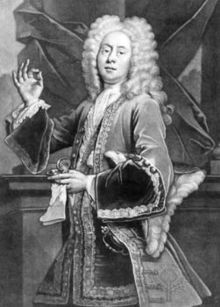
"Lord Foppington" from the play "The Relapse" 
(1696 AD)

A canny commentator on YouTube, reflecting on an analysis of his actions, noted that his feelings and reactions to situations, especially involving being in the presence of couples, were almost a comic parody of particular 17/18th century aristocrats - foppish, prudish, effete and deeply temperamental to all and any perceived slights to their status. Of course, in the more charged, rugged and ribald scene of Isla Vista - Santa Barbara's college district - this worked unfortunately against him; singling him out for typical insults, and not helped by his slight build and delicate complexion.


The salience of privilege and social class in this event a potent and somewhat underrepresented, it remains to me here to present some essential conclusions, without making this part overlong. It remains that Elliot Rodger's world was colored by privilege and by a class identity which he had no reservation about projecting; something which he absorbed, witnessed through coded situations or felt was alluded to while growing up. Unfortunately, Elliot's other issues seemed to preclude a more nuanced, critical understanding where this class identity was supposed to have traction among his peers - and especially among women he believed would comport themselves in choosing him as a socially sound alternative to other, "lesser" men. Of course, it remains that Elliot's ardent, patrician beliefs - both before and during his time in Santa Barbara - also register as a way of defending himself in the social order of things; this compared to the more disparate, heterogeneous nature of his background, which he almost certainly felt gave his position less voice and agency.


In all, could it be postulated that class perceptions played a distinct role in evolving Elliot into the shooter he would become? I can confidently say yes - albeit it must be noted that Elliot's understanding of his situation, and the vocabulary he drew from it, promotes two distinctions. In the first, it does mark how problematic class constructions can be when understood from a very skewed or corrosive perspective: Elliot's deeply obtuse opinion about what should be his by right and the candor of entitlement guaranteeing alienation in return. In the second, Elliot's perspective affords us a, admittedly extreme, glimpse of what can occur when privilege - compounded by learning difficulties and mental illness - departs from any adherence to wider, more general values of behavior.


In some sense, it's heartening to know that the most blunt and obtuse of privileged positions - held aloft by money, consumerism and ostentation - doesn't hold as much traction as it used to, and especially in the case of those who saw fit to bare out their position in hopes of others being socially or sexually obliged. But, it remains that the singular influence of class and social status in the dynamic of American society - and its indwelling problems - requires careful scrutiny to nurture any hope of progress; a scrutiny that must have the conviction to understand what it finds, and how to deal with it for the better. Returning to Neil Diamond, money does - and will continue to - talk, but what it is made to say must always meet with keen scrutiny, and sometimes refusal when money tries to talk over us.


3) Mentall Illness & Pathological Ideation


Of all the issues promoted to the fore by the deeds of Elliot Rodger, the salience of mental illness  - wither to a greater or lesser extent - has been often bitterly contested across the social spectrum. It also remains one of the most difficult to discuss as it not only conflates with innate personality and developmental problems but is hard to accurately qualify too. Coming to the last component of my model, we will now consider the influence that mental illness exerted on Elliot's life, and if this played such a decisive role in bringing the Santa Barbara shooter to his conclusions. Still, given Elliot's phenomenology, chasing mental illness is like chasing a genuine phantom through a theme park haunted house: difficult, open to distraction but possible if sufficiently focused.


To begin, I feel it important to assert that Elliot's personal and developmental issues didn't destine or condemn him to mental illness. Rather, as they unfortunately do with a swathe of others far more grounded than he ever was, problems can evolve in the most ostensibly sound minded and successful. Did then Elliot's problems invest him with a latent disposition? This is debatable, but far from definite. Those with atypical mentalities and different developmental histories can be more receptive to extreme experiences which can lead to difficulties. But still, the same can be said of others in the mainstream of society who encounter situations or have singular experiences which trigger perennial psychological problems, later on.


The mental health of the human being is a complicated and challenging thing but can find a commonality in that mental health issues are extremely important: the wider the forum, the sooner undue stigma and prejudice lessens in wider society.


With a focus upon the very singular Elliot Rodger, I would like to postulate that his already difficult, problematic personality distended into mental illness when a number of factors converged, around the time of his 19th birthday, resulting in the creeping, but not inevitable, slide towards disaster seen in the years afterwards.


Elliot's 19th year finds, in the first, a growing frustration between his parents that their son's life has stagnated; and more so, Elliot's traditional, small collection of friends grow increasingly distant between themselves: some growing in different directions, while Elliot's increasingly vicious opinions make a relationship with him almost intolerable. At this point, Elliot's parents contrive a decisive plan which will prefigure much of what comes after, in a bitterly ironic way. Proposing that Elliot begins a new college career in coastal Santa Barbara meets well with Elliot, but his move to the town - despite his ostensibly best resolutions - meets with poor prospects from the outset. Despising successive groups of roommates and the local population of students while bemoaning a lot which he sabotages continuously.


His position in the town is not framed as just another chance, as he deems it, but as a "last chance" - Elliot considering that if he can't fulfill his ideal lifestyle here, then it will never come to pass. Not wishing to consider returning to his mother's residence, he cannot envision a successful life for himself beyond failure in Santa Barbara: a reasoning which poisons his mentality even further when he cannot bring various aspirations - most notably winning the lottery - to fruition. Elliot's mental state ever declining, previous reservations are cast aside as he sinks into a psychosis: ever more obsessive, angry and prone to randomly assaulting strangers who either offend him just by being, or don't behave as he deems fit.


This behavior not going completely without check, a particularly violent tantrum finds Elliot prescribed anti-psychotic medication with some proven efficacy over autistic behavior. Elliot refuses this and there is little intervention further as he, in a tumult of vindictive entitlement, plots his solution to his failures: a final retort to the world he garishly calls "The Day of Retribution", to be carried out in Isla Vista, the town's college district which he has come to hate.


Elliot's reasoning by now far divorced from reality, and pathologically stained, his remaining year in the town bares out the behavior of this mentally ill man. Most notably, as found in an examination of his manifesto, we find his psychotic delusions given to flights of self-justification. Increasingly framing his anger at the world as a fury at women - the seeming gatekeepers to his social validation - and to the men who work to deny him and cultivate women's attentions, he considers these two groups to be the principal embodiment of a world that has denied him his rightful place as their natural better.


When enacted most infamously, he charges the world with the responsibility to save itself from his impeding violence by granting him sex when he ventures out to a party. Frustrated and denied, as usual, Elliot's anger is fueled by alcohol when he insults a group near a balcony he arrives at; the insults rendered back enraging his entitlement as he tries to push several woman over this balcony. The group respond with a scuffle which finds Elliot pushed over, breaking his leg and shambling away - only returning to receive a beating when he finds his glasses have been lost: the group spuriously blamed for "taking his sunglasses" while he is tone deaf as to how the incident actually came about.


Police cordon the scene of Elliot's crashed car (Black BMW center)


By this point the incident only delays the inevitable as Elliot feels his reasoning has been vindicated. Having already acquired a small arsenal, Elliot continues to nurse a small slither of hope that the world will, even at the eleventh hour, recognize his natural estate and grant him what he truly deserves. Of course, this outrageous, stunted belief never comes to pass and what follows finds the last of Elliot's psychotic episodes: the killing of six, the wounding of thirteen and a brief gun fight with police which he, of course, loses and crashes his car. Wounded and ultimately denied of the massacre he desired, Elliot shoots himself in the head. Dragged from the car, police and ambulance crews pronounce Elliot Rodger dead at the scene.


Elliot's mental decline after 19 is difficult, but precipitous, and would certainly have challenged those around him to discern that something was increasingly wrong with a man who's behavior was always challenging from his earliest years. Still, it remains that - in the absence of a more temperate reaction from Elliot - the reaction of others is suspect, and does contribute towards his behavior later on. Though his parents were certainly right to call for a psychiatric intervention, it seems that there was no invested attention after when Elliot coolly refused treatment; more so, the police response to his parent's concerns was stunted by Elliot's composed reaction - something the shooter remarked upon later, noting that if they saw fit, they could have precluded his plans there and then.


Still, it lingers in the mind that the response to much of Elliot's declining mental health after the age of 19 was an ill-informed, conceited and distinctly at arms length. Of course, this final, sporadic chapter of Elliot's life is one peppered with speculation as to what, how and why - possibilities and probabilities that many will mull over for years to come. But, it remains that the framing of Elliot's behavior - wither they were half hidden and furtive or not - is dubious, considering how little was done towards a more substantial move to secure and treat what was an unstable, increasingly aggressive person in a community that should have been more perceptive of health problems than most, at all levels.


Conclusions: what can we learn from the life of Elliot Rodger?


Drawing conclusions and proffering prescriptions has become, and will remain, some of the most difficult things a society can become tasked with - more so especially as it nips certain assumptions and challenges the everyday narrative.


As I said before opening, I considered that Elliot's life and ultimate end were framed by three factors or dynamics: these now discussed as above with Asperger's Syndrome and developmental issues, social status and privilege with mental illness and pathological ideation. These, I feel with some conviction, formed the essential parameters of Elliot Rodger's experience and it may be said that from an understanding of these, we can perhaps glean some insight into just what happened with events preceding the Santa Barbara shootings.


In the hope that the respective elements above have stirred some interest in their content, or have added some deeper nuance to the wider issue, I would like to draw these together in a singular way, if I can.


Elliot Rodger's life and his development were uneven, staggered and problematic; a conclusion his family, peers and sundry authorities tend to agree on. But, from the beginning, it would seem that Elliot's development was one defined by guarded, linear responses as opposed to growth and greater cultivation; interventions and reaction as opposed to better planning and working within a more cohesive framework which a singular diagnosis would usually have prompted. Given what is known, it would seem that Elliot's life was not colored by any particular understanding or penetration of his conditions and his mentality, uncultivated and untempered, which increasingly whirled out of control over the years as he grew.


In any respect, this would have been problematic, but it remains that the social and cultural landscape, in which Elliot was orientated, were ones in which status, social primacy and the affirmation of hierarchy were very important; a context in which, it could be mused, that validation of class identity would and could lead to future success and personal vindication. This competitive, driven and far from healthy mentality is challenging for most, but to the skewed, blunted mind of Elliot, the symbiosis of these values with his own perspectives created a world view which held that overt display, and appreciation of, social rank should, and would, open all doors.


Elliot, seemingly flying first class
Of course, the fallacy of this belief was brutally revealed to the growing Elliot over the years; the social narrative he found - far more nuanced than he could understand - reflecting a more complex world of identity, needs and the means to them. Elliot, with growing urgency, battled with this: believing that the validation of his estimated class would solve his problems of masculinity, race and personal relationships. In essence, the world didn't need to be negotiated with, it just had to be reminded about who was "on top" and everything would fall into place once people recognized the natural egress of things, from top to bottom. The truth was far more tricky than Elliot imagined, and he found himself, at least in the better sense, on the losing side of his nascent world view.


The tide having so overwhelming turned against him, the cognitive dissonance would have been painful for all but was world shaking to Elliot; a man who's world view staked so much on the affirmation of his societal class and identity, beyond any other quality he deemed of lesser significance. His views tempered to the extreme by anger, frustration and stark incomprehension, he increasingly charged his future with this desperation; a desperation compounded as his declining mental and emotional health alienated peers and parents alike as they struggled to live with his spiraling behavior. His views orientated to the increasingly pathological, the narrative that emerged as he moved to Santa Barbara was one of acrimonious entitlement - something that fueled his angry ideation through those last few years of his life; his mentality bringing his life into an ever more stark relief of absolute success and validation, or seemingly nothing at all.


The spasmodic decline of his mental health documented in numerous incidents and encounters, he sought to rationalize the clumsy congerie of  beliefs he held. Most notably, as with the authorship of his manifesto, he identified that the gatekeepers of the unfair, unjust society he would war against were young women - particularly as they had denied him the wider validation he felt was his through their lack of obligation. Seen to be complicit in this were the men - all and any - that Elliot felt either impeded him or somehow challenged his person hood. In the last, Elliot feeling so singularly impugned, would retaliate in the shootings of May 23rd 2014 - very much removed from Elliot's aggrandised vision, but at a deadly, tragic cost none the less in the deaths of six, the wounding of thirteen and the scarring of a community in turn. And, of course, Elliot himself died too.


Elliot Rodger's Crimes - Santa Barbara, 23rd May 2014

If asked how such a process of events could have been avoided, it would be somewhat overlong, but as with the three factors, there would also be three prescriptions. In the first, mental and developmental difference must be taken seriously by parents, teachers and authorities at large; the wider world already less than happily disposed to those of atypical mentality, it remains that the autistic, and assorted other conditions, must be better received and incorporated into a normative, successful narrative, for the betterment of all.


Following, in a world where the fantasy of class dissolution is actively indulged from top to bottom, it remains that the values and beliefs that Elliot found himself exposed to came from somewhere; more holistically, it stands to what can become of someone of socially charged entitlement and privilege who then suffers an incremental melt down when things don't acquiesce to the supposed way that makes the world work. Even if that person was evidently embodying a deeply pathological interpretation of such beliefs, the dynamic of those beliefs must be scrutinized also to determine if real reform could help preclude such problems from arising in the first place.


The mental illness that compounded the former two remains nebulous, though psychological problems are not always fairly considered and are subject to stigma or prolonged marginalization; sensationalized by some and effaced by others in the respect of this case, in favor of competing explanations for Elliot's actions. If Elliot's original decline was perhaps caught, or at least tracked over some years, by more receptive parenting or engaged authorities - the latter more assertive about the severity of such behavior and what it might entail - it could very well be that Elliot could have been confined and treated as the imperative determined.


Taken together, a firm diagnosis or progressive development conflated with a more nuanced, critical social education would have dampened the ideation of certain beliefs before outright pathological behavior emerged during Elliot's earlier years. Of course, there will be numerous other insights and compelling arguments, though this hypothesis occurs to me as both the most valid and resonant, considering the wider context of Elliot's life and actions.


In a final prescription, I will note with a somber conviction that Elliot Rodger remains responsible for his actions that night in mid 2014, but this alone does little in the way of better understanding or, more so, precluding such incidents happening again. In this, I choose, a more holistic orientation as to the events which preceded the shooting and do believe that a more critical perspective is very much necessary. Elliot Rodger charged himself with personal vindication through affirming a number of values in his wider society; values and beliefs which he saw, albeit skewed, but saw none the less as a way to validation and success. Could it have been that, perhaps sometime during his earlier years or later education, that a infusion of critical awareness of the world around him would have enabled him to think more constructively, while also pursuing a less ignorant, more temperate place in it? It's certainly possible, though unfortunately didn't come to pass.


In a better world, I do believe that more critical perspectives on class, social democracy and the dynamics of social relationships throughout society, would be essential to a place in which events like the Santa Barbara shootings would be rare. And more, to be treated as a indictment of wider, more systemic issues - truly an opportunity to learn and grow - as opposed to dispersing the issue among numerous, not always temperate, agendas and returning to a mainstream, cyclical narrative which leads nowhere.


Thank you,


Clark Caledon.


20/02/2015.